Babinski Sign: How to Elicit, Meaning, Normal vs Abnormal Response




# **Babinski Sign – Complete, Concise Medical Explanation**
## **SEO Title**
**Babinski Sign: Definition, Physiology, Causes, Interpretation & Clinical Importance**
---
# **1. Definition**
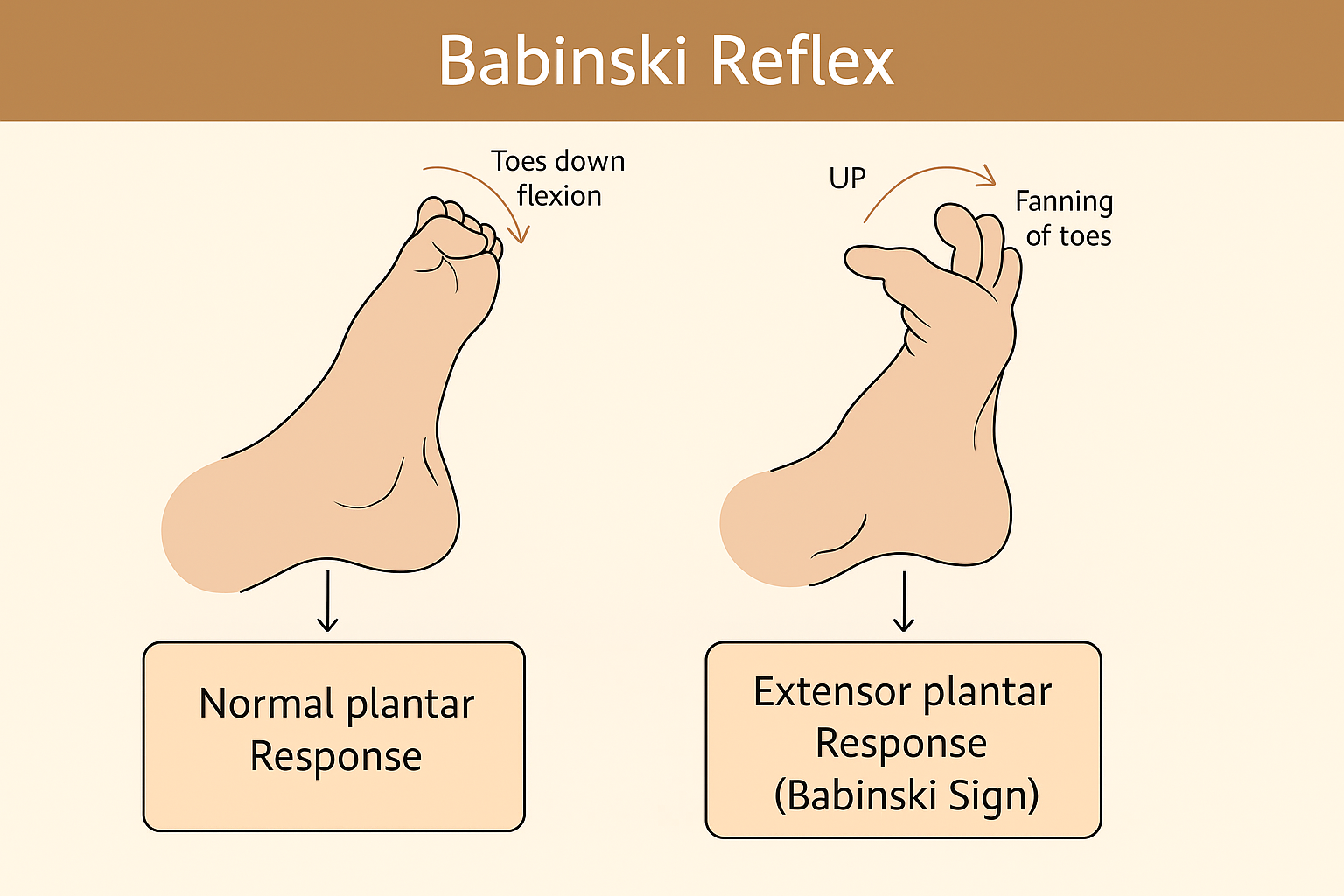
**Babinski sign** (also called **extensor plantar response**) is an abnormal **upper motor neuron (UMN)** reflex characterized by:
* **Dorsiflexion (extension) of the great toe**
* **Fanning of the other toes**
* **After stroking the lateral aspect of the sole of foot**
A normal (negative) response in adults = **plantar flexion** of toes.
---
# **2. Neurophysiology / Pathophysiology**
* The plantar reflex is mediated by **S1 nerve root** via a cortical inhibitory pathway.
* **UMN lesions remove the inhibitory control** of the corticospinal tract.
* Loss of inhibition → **primitive extensor response (found in infants)** reappears in adults.
Hence Babinski = **marker of corticospinal tract dysfunction**.
---
# **3. Technique (How to Elicit)**
Stroke firmly with a blunt object:
1. Lateral border of sole →
2. Curve medially across ball of foot (J-shaped pattern)
Observe **toe movement**.
---
# **4. Interpretation**
### ✔ **Positive Babinski (Abnormal in adults)**
* Great toe extends upward
* Other toes fan out
### ✔ **Negative Babinski (Normal in adults)**
* All toes flex downward
### ✔ **Normal in Infants**
Up to **12–24 months** due to incomplete myelination.
---
# **5. Causes of Positive Babinski Sign**
### **Upper Motor Neuron Lesions**
1. **Stroke**
2. **Spinal cord injury**
3. **Multiple sclerosis**
4. **Brain tumors**
5. **Motor neuron disease (e.g., ALS)**
6. **Traumatic brain injury**
7. **Cerebral palsy**
8. **Meningitis / encephalitis** (less common)
### **Metabolic / Toxic Causes**
* Severe **hypoglycemia**
* **Anesthesia** or drug-induced suppression
* **Epileptic seizures** (postictal period)
---
# **6. Clinical Features Associated**
Often seen with other UMN signs:
* **Hyperreflexia**
* **Spasticity**
* **Clonus**
* **Weakness (pyramidal pattern)**
---
# **7. Differential Diagnosis (False Positives)**
A Babinski-like response may appear due to:
* **Ticklish withdrawal response** → NOT true Babinski
* **Poor technique**
* **Deep sedation / coma**
---
# **8. Clinical Importance**
* **Most important sign of UMN lesion**
* Helps localize lesion anywhere from:
**motor cortex → internal capsule → brainstem → spinal cord**
* Distinguishes **UMN vs LMN weakness**
---
# **9. Variants of Babinski Sign**
Alternative methods that also produce great toe extension:
* **Oppenheim** → knuckle pressure on tibial crest
* **Gordon** → squeezing calf muscles
* **Chaddock** → stroking lateral malleolus
---
If you want, I can also provide:
✅ **SEO description & keywords**
✅ **HTML/CSS/JS infographic or notes**
✅ **Comparison chart: Babinski vs Oppenheim vs Chaddock**





# **Babinski Sign – Complete, Concise Medical Explanation**
## **SEO Title**
**Babinski Sign: Definition, Physiology, Causes, Interpretation & Clinical Importance**
---
# **1. Definition**
**Babinski sign** (also called **extensor plantar response**) is an abnormal **upper motor neuron (UMN)** reflex characterized by:
* **Dorsiflexion (extension) of the great toe**
* **Fanning of the other toes**
* **After stroking the lateral aspect of the sole of foot**
A normal (negative) response in adults = **plantar flexion** of toes.
---
# **2. Neurophysiology / Pathophysiology**
* The plantar reflex is mediated by **S1 nerve root** via a cortical inhibitory pathway.
* **UMN lesions remove the inhibitory control** of the corticospinal tract.
* Loss of inhibition → **primitive extensor response (found in infants)** reappears in adults.
Hence Babinski = **marker of corticospinal tract dysfunction**.
---
# **3. Technique (How to Elicit)**
Stroke firmly with a blunt object:
1. Lateral border of sole →
2. Curve medially across ball of foot (J-shaped pattern)
Observe **toe movement**.
---
# **4. Interpretation**
### ✔ **Positive Babinski (Abnormal in adults)**
* Great toe extends upward
* Other toes fan out
### ✔ **Negative Babinski (Normal in adults)**
* All toes flex downward
### ✔ **Normal in Infants**
Up to **12–24 months** due to incomplete myelination.
---
# **5. Causes of Positive Babinski Sign**
### **Upper Motor Neuron Lesions**
1. **Stroke**
2. **Spinal cord injury**
3. **Multiple sclerosis**
4. **Brain tumors**
5. **Motor neuron disease (e.g., ALS)**
6. **Traumatic brain injury**
7. **Cerebral palsy**
8. **Meningitis / encephalitis** (less common)
### **Metabolic / Toxic Causes**
* Severe **hypoglycemia**
* **Anesthesia** or drug-induced suppression
* **Epileptic seizures** (postictal period)
---
# **6. Clinical Features Associated**
Often seen with other UMN signs:
* **Hyperreflexia**
* **Spasticity**
* **Clonus**
* **Weakness (pyramidal pattern)**
---
# **7. Differential Diagnosis (False Positives)**
A Babinski-like response may appear due to:
* **Ticklish withdrawal response** → NOT true Babinski
* **Poor technique**
* **Deep sedation / coma**
---
# **8. Clinical Importance**
* **Most important sign of UMN lesion**
* Helps localize lesion anywhere from:
**motor cortex → internal capsule → brainstem → spinal cord**
* Distinguishes **UMN vs LMN weakness**
---
# **9. Variants of Babinski Sign**
Alternative methods that also produce great toe extension:
* **Oppenheim** → knuckle pressure on tibial crest
* **Gordon** → squeezing calf muscles
* **Chaddock** → stroking lateral malleolus
---
If you want, I can also provide:
✅ **SEO description & keywords**
✅ **HTML/CSS/JS infographic or notes**
✅ **Comparison chart: Babinski vs Oppenheim vs Chaddock**















Comments (3)

Medical Student
This was incredibly helpful for my upcoming exam. Thank you!
Nursing Professional
Great explanation of the ECG changes in hyperkalemia!